Spaced Practice: The Most Underrated Study Strategy

Spaced Practice: The Most Underrated Study Strategy
You’ve seen it countless times: students confidently revising the night before a test, only to struggle when that same content appears weeks later in a mock exam or final assessment. They spend hours cramming, achieve short-term success and then forget almost everything within days.
There’s a better way to help students build lasting retention. It’s called spaced practice and research shows it’s one of the most powerful learning strategies available. The challenge? It requires planning, trust in the process and a shift away from the last-minute revision culture that dominates many classrooms.
This guide explores how spaced practice works, why cramming fails students in the long term and how you can help them build realistic, effective revision timetables.
Why Cramming Feels Like It Works (But Doesn’t)
Cramming persists because it produces visible short-term results. Students spend hours revising, recognise material during the test, and often achieve passing grades. From their perspective, the strategy “worked.”
The problem is what happens next. Research consistently shows that cramming creates what psychologists call “the illusion of competence.” Students feel confident because the material is temporarily accessible, but this familiarity masks a lack of genuine understanding.
The statistics are stark: within 24 hours of cramming, students forget 50-80% of what they “learned.” Within a week, retention drops even further. When final exams arrive months later, students must essentially relearn content from scratch – a cycle that wastes time and undermines confidence.
How Students’ Brains Actually Learn
Understanding the neuroscience helps us teach more effectively. When students encounter information once and never revisit it, their brains treat it as unimportant. Neural pathways weaken and the information becomes increasingly difficult to retrieve.
However, when students study material and then return to it after a delay, their brains receive a different signal: this information is valuable and worth storing long-term. The act of effortful retrieval strengthens neural pathways, making future access easier.
This is the foundation of spaced practice. By helping students distribute their learning over time, we’re not just encouraging better revision habits – we’re leveraging fundamental principles of memory formation.
What Spaced Practice Actually Looks Like
Spaced practice (also called distributed practice or spaced repetition) means spreading study sessions over days, weeks or months rather than concentrating them into intensive blocks.
Here’s how the approaches compare:
Cramming approach:
Spaced practice approach:
Both approaches involve similar total study time but the spaced approach produces dramatically better long-term retention. Studies consistently show improvements of 20-50% on delayed assessments, with benefits increasing over time.
The Science: Why Spacing Beats Cramming
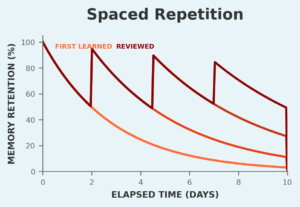
The Testing Effect: Every time you retrieve information from memory, you strengthen it. Spaced practice forces repeated recall, creating stronger memory traces than re-reading.
Desirable Difficulties: When retrieval becomes slightly harder (you’ve started to forget), your brain works harder, creating more durable memories. Cramming feels easier, but that ease is deceptive.
Sleep and Consolidation: Your brain processes memories during sleep. Spacing over multiple days gives your brain multiple sleep cycles to strengthen those memories.
The Forgetting Curve: By reviewing material just as you’re starting to forget it, you reset the forgetting curve at a higher level. Each spaced review makes the information more resistant to forgetting.
Helping Students Build Effective Revision Timetables
One of the most valuable skills we can teach is how to create realistic, sustainable revision timetables. Here’s a framework you can share with students or use as the basis for revision planning sessions:
Step 1: Help Students Audit What They Need to Learn
Encourage students to list all subjects and topics with specificity:
Generic entries like “revise Biology” are too vague. Breaking content into manageable chunks makes the task feel achievable.
Step 2: Teach Realistic Time Calculation
Many students create aspirational timetables that ignore reality. Help them honestly assess available time, accounting for school, homework, activities, social time, sleep, and family commitments. If a student realistically has 2 hours on weekday evenings and 5 hours on weekend days, that’s what they should plan for – not the 6 hours daily that looks good on paper but never happens.
Step 3: Introduce the 1-3-7-21 Spacing Pattern
This simple framework provides structure without overwhelming students:
For example, if students learn about photosynthesis in Monday’s lesson:
Step 4: Encourage Interleaving
Students shouldn’t spend entire days on single subjects. Mixing topics within sessions improves discrimination and retention:
Effective structure:
Ineffective structure:
Step 5: Provide a Realistic Weekly Structure Template
Share this practical framework with students:
Monday-Friday (School days):
Saturday-Sunday (Weekends):
This provides approximately 10-15 hours per week – realistic and sustainable without causing burnout.
Step 6: Build in Flexibility
Remind students that life is unpredictable. Timetables should include:
A timetable students can actually follow is infinitely more valuable than a perfect timetable they abandon after three days.
Supporting Students to Implement Spaced Practice
Encourage Starting Small: Students shouldn’t overhaul everything overnight. Suggest beginning with one subject, just the 1-day and 3-day reviews, and 15-minute sessions. They can expand gradually once habits form.
Emphasise Active Recall: Spaced practice works best with active retrieval. Teach students to test themselves without notes first, identify gaps, then check. Encourage flashcards for difficult concepts and explaining topics aloud.
Help Students Track Progress: Provide simple tracking templates where students can tick off completed sessions and note topics needing extra attention. Celebrate consistency over perfection.
Introduce Digital Tools Judiciously: Apps like Anki, Quizlet, or Google Calendar can automate spacing, but don’t let technology become a barrier. Paper timetables and flashcards work equally well.
Protect Sleep Above All Else: Sleep is when memory consolidation occurs. Students who sacrifice sleep for extra revision undermine the benefits of spacing. Encourage 8-9 hours nightly with consistent schedules. If they must choose between studying and sleeping, they should choose sleep.
Common Mistakes to Avoid
Spacing too conservatively: Use gradually increasing intervals (1 day, 3 days, 7 days, 21 days), not just one day apart.
Making sessions too long: Multiple short sessions (25-45 minutes) spaced over days beat single marathon sessions.
Only reviewing when things feel easy: If retrieval feels easy, you’re not spacing enough. Embrace the slight difficulty.
Abandoning spacing when tests approach: Students who maintain spaced practice right up to exams consistently outperform those who cram.
Confusing coverage with learning: Ticking off topics doesn’t mean you’ve learned them. Use active testing in each session.
A Practical Example: 6-Week GCSE Revision Programme
Here’s how you might guide Year 11 students through implementing spaced practice:
Week 1-2: Foundation Building
Week 3-4: Consolidation Phase
Week 5: Intensive Spacing
Week 6: Final Preparation
This structure ensures multiple spaced reviews of every topic before exams, without requiring unrealistic daily time commitments.
The Bottom Line: Building a Culture of Spacing
Spaced practice feels counterintuitive to students accustomed to cramming. They see immediate results from last-minute revision and struggle to trust that distributed practice will prove more effective.
This is where your guidance becomes crucial. The science is unequivocal: spaced practice produces dramatically better long-term retention with comparable or less total study time. Students who embrace spacing consistently outperform those who cram, particularly on cumulative assessments and final exams.
Yes, spacing requires earlier starts and systematic planning. Yes, it requires students to trust they’ll remember partially forgotten material. But the alternative, the exhausting cycle of cramming, forgetting, and relearning, wastes far more time and produces inferior results.
By teaching spaced practice explicitly, providing timetabling support and building spacing into your classroom routines, you’re not just helping students pass exams. You’re teaching them how to learn effectively, a skill that will serve them throughout their education and beyond.
Ready to learn more evidence-based study strategies? Positively You’s Super Speed Study Skills workshop covers spaced repetition, interleaving, retrieval practice, and practical timetabling strategies that actually work. For over 20 years, we’ve helped students across the UK develop sustainable revision habits that lead to better results and less stress. Visit positivelyyou.org.uk or call 01983 294737 to book a workshop for your school.
 Back To News





A fantastic way for students to consolidate the ideas and techniques they were introduced to during a live workshop.
Learn more